


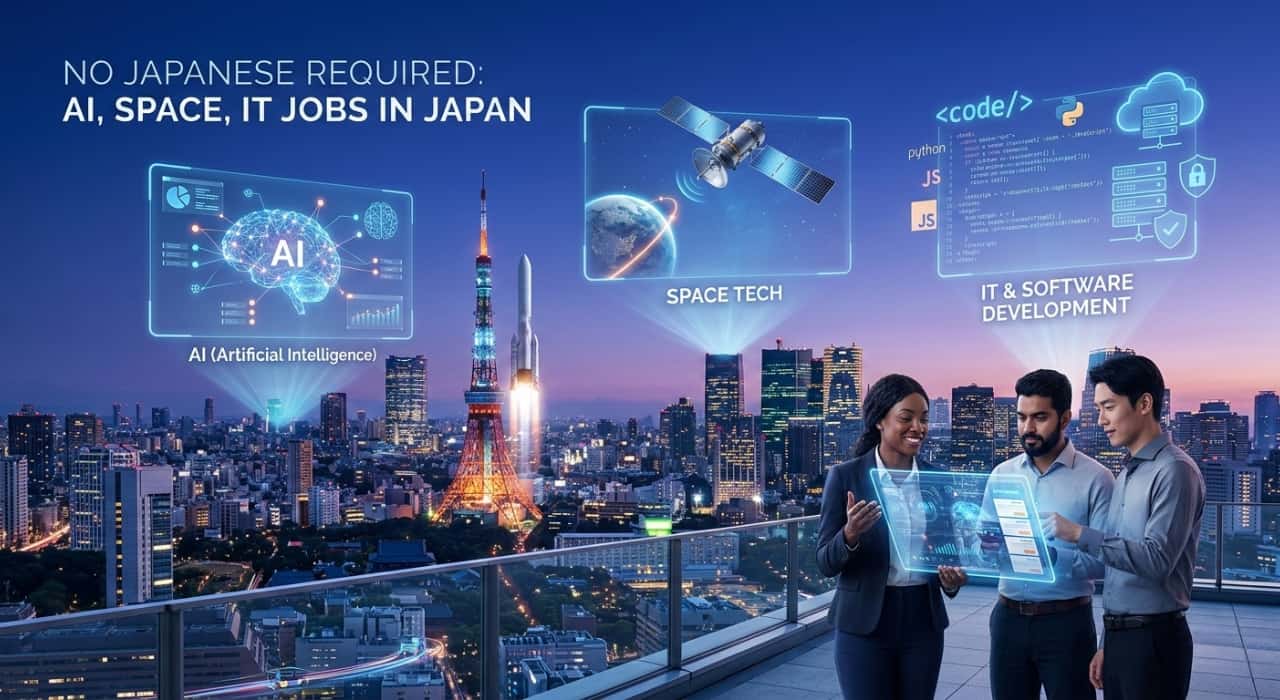
“I want to work in Japan, but my Japanese isn’t good enough.”
For years, this thought has stopped world-class talent from entering the Japanese market. The “JLPT N1/N2 wall” felt insurmountable—until now.
As Japan accelerates its push into the global tech frontier, a massive shift is happening. In high-stakes fields like AI, Space Tech, and IT, the common language isn’t Japanese—it’s innovation. For companies building the future, your ability to optimize a neural network or design a satellite system is far more valuable than your ability to read thousands of Kanji.
Today, we’re diving into the three most exciting industries where your English proficiency and technical expertise are your primary tickets to a thriving career in Japan.
3 High-Demand Sectors for English Speakers
1. AI (Artificial Intelligence) & Machine Learning
The AI race in Japan is heating up. With the establishment of global AI hubs in Tokyo and the rise of well-funded Japanese AI startups, the talent war is fierce. Because the latest research, libraries, and global benchmarks are all in English, these teams operate as international entities.
- Why “English Only” Works? Development teams are often 60–80% international. The priority is your ability to implement LLMs or optimize neural networks, not your ability to read Kanji.
- Top Roles: ML Engineer, Data Scientist, LLM Researcher, AI Product Manager.
2. Space Tech (NewSpace)
Japan is a global leader in space exploration, but the “NewSpace” movement (private startups) has changed the game. Companies working on lunar landers, satellite constellations, and orbital debris removal are inherently global. They collaborate with NASA, ESA, and international suppliers daily.
- Why “English Only” Works? Space is a global industry by nature. Most documentation, safety protocols, and international partnerships are handled in English.
- Top Roles: Aerospace Engineer, GNC (Guidance, Navigation, and Control) Specialist, Satellite Embedded Systems Developer.
3. General IT & Modern Software Development
From FinTech to E-commerce giants and SaaS unicorns, the “modern” IT sector in Japan has largely moved toward English-speaking engineering cultures to attract top global talent. These companies focus on agile environments where technical excellence is the only metric that matters.
- Why “English Only” Works? These firms often have “English as the official language” policies or international engineering departments designed to bypass the domestic labor shortage.
- Top Roles: Full-Stack Developer, DevOps/SRE, UI/UX Designer, Cybersecurity Analyst.
[Monthly Update] Featured English-Only Positions
We’ve picked out featured job openings from our daily-updated job board.
[As of Oct 9, 2026]
| Sector | Position | Your Role | Key Requirement |
| AI | Robotics Software Engineer | Design and build the on-robot runtime: ROS 2 nodes, task orchestration/state machines, safety guards, and recovery behaviors. |
|
| AI | Full Stack Engineer | Design and implement scalable full-stack systems for large-scale robot data collection, including real-time teleoperation interfaces, monitoring dashboards, and APIs for seamless integration with ML platforms. |
|
| AI | Research Engineer/ Scientist | Research and develop state-of-the-art Speech Language Models. Build, generate, and preprocess large-scale speech datasets. |
|
| Space | GNC Flight Software Engineer | Develop and maintain Guidance, Navigation, and Control (GNC) flight software in C/C++ and Python. Responsible for spacecraft dynamics simulations, sensor and actuator modeling, GNC algorithm prototyping, CI/CD pipeline automation, and cross-functional team collaboration. |
|
| Space | Senior Ground Platform Engineer (Senior SRE ) | Design and Operate Cloud Infrastructure for Mission-Critical Satellite Ground Systems. |
|
| Space | AOCS engineer / Senior AOCS engineer | Design, implement, test, and validate algorithms used in the Attitude and Orbit Control System (AOCS) of Synthetic Aperture Radar (SAR) satellites. |
|
| IT | Senior Rust Backend Engineer | Design, implement, and optimize the backend services that power their exchange interfaces – ensuring low latency, resilience, and correctness under load. |
|
| IT | Machine Learning Engineer | Understand stakeholder needs and develop advanced analytics models—leveraging SAR imagery and multimodal data—while collaborating cross-functionally to deliver insights, optimize solutions, and drive continuous improvement. |
|
You can find more opportunities on Talisman Job Board!
Beyond the Language: Key Success Factors for English-Only Candidates
While these high-tech sectors don’t require Japanese fluency, the competition remains high. To stand out, recruiters look for a specific “global-standard” profile. Here is what truly matters when your Japanese skills aren’t the focus:
A Proven Track Record (Technical Dominance)
In an English-only environment, your code, your portfolio, and your past projects are your primary resume. Since the company is bypassing the local labor pool to hire globally, they expect high-level technical mastery.
- Show, Don’t Tell: Whether it’s a GitHub repository for AI models, a portfolio of successful SaaS launches, or specific aerospace certifications, you must prove you can hit the ground running without needing technical hand-holding.
- The “Niche” Advantage: Specialized expertise in emerging tech (like LLM fine-tuning or satellite propulsion) makes you indispensable, regardless of the language you speak.
Global Mindset & Collaborative Leadership
Working in an international team in Japan is different from working in your home country. Companies value candidates who can bridge the gap between different work styles.
- Inclusive Collaboration: Can you navigate a team where half the members are Japanese and the other half are from ten different countries? Demonstrating “Emotional Intelligence” (EQ) and the ability to mentor junior developers across cultural lines is a massive plus.
- Adaptability: Showing that you are flexible with different methodologies (e.g., transitioning from traditional Japanese project management to Agile) proves you are a “culture-add,” not just a “culture-fit.”
Technical Communication: Precision over Fluency
You don’t need to be a Shakespearean orator, but you must be a precise communicator. In high-stakes fields like Space Tech or AI, a misunderstanding can be costly.
- Clarity & Brevity: The ability to explain complex architectural decisions or data trends in simple, actionable English is vital—especially when communicating with stakeholders whose first language might not be English.
- Documentation Skills: Strong written communication for technical documentation and Slack-based collaboration is often more important than verbal fluency.
The Secret Weapon: Cultural Curiosity & Respect
Even if the office language is 100% English, you are still living and working in Japan. Genuine interest in Japanese culture is a significant professional advantage.
- Long-term Commitment: Hiring from abroad is an investment. If you show that you enjoy Japanese life, understand basic social etiquette, and are making an effort to learn the “vibe” of the country, recruiters view you as a lower flight risk.
- The “Soft” Bridge: Understanding Japanese “Omotenashi” (hospitality) or the importance of consensus-building (Nemawashi)—even if you discuss these concepts in English—helps you build trust with Japanese colleagues and executives much faster.
Frequently Asked Questions: Working in Japan Without Japanese
To help you navigate your move, here are some of the most common questions about “English-only” careers in Japan’s high-tech sectors.
Q: Is it really possible to get a Work Visa without JLPT certification?
A: Yes. The Japanese Immigration Bureau does not require a Japanese Language Proficiency Test (JLPT) for most “Engineer/Specialist in Humanities” visas. Your eligibility is primarily based on your university degree or 10+ years of relevant professional experience, along with a signed contract from a company in Japan. In sectors like AI and Space Tech, your technical skills are the priority for both the employer and immigration.
Q: Which city has the most “English-only” job opportunities?
A: Tokyo is the primary hub for English-only roles. The vast majority of international tech firms, AI startups, and global headquarters are concentrated in Tokyo (especially in the Minato, Shibuya, and Chiyoda wards). While cities like Fukuoka (Startup Hub) and Tsukuba (Research City) are growing and occasionally host international projects, the volume of English-only positions there is still limited. For the widest range of opportunities and the highest chance of landing a role without Japanese fluency, we recommend focusing your search on the Greater Tokyo Area.
Q: Will my salary be lower if I don’t speak Japanese?
A: In the AI, Space, and IT sectors, the opposite is often true. Because these roles require specialized global expertise, “English-only” positions at international startups and global tech firms often offer higher-than-average salaries compared to traditional Japanese-speaking roles in older domestic companies. However, if you are currently working for a top company in the US or Europe, these salaries may be lower compared to equivalent positions in your home country. Be sure to confirm salary details thoroughly during interviews.
Q: Do I need to learn Japanese once I arrive?
A: While you can thrive professionally in an “English-only” office, learning basic Japanese (N5 or N4 level) is highly recommended for daily life. Being able to navigate government offices, hospitals, and local restaurants will significantly improve your quality of life and show your commitment to your team.
🚀 Ready to Start Your Japan Chapter?
The door is open for experts in AI, Space, and IT. If you have the skills and the mindset, the language barrier is a thing of the past.
Check out the latest openings on the Talisman Job Board—filtered specifically for “English Only” opportunities.
Browse “English-Only” Jobs on Talisman Job Board ↗︎