


Autonomous driving technology holds immense potential to solve social issues such as reducing traffic accidents, easing congestion, improving transportation efficiency, and mitigating environmental impacts. Simultaneously, this technology has fostered a new industrial ecosystem involving not only automakers but also IT companies, telecommunications firms, semiconductor manufacturers, and battery makers.
Consequently, demand is surging for professionals with expertise in autonomous driving. New career opportunities are emerging across a wide range of roles, including software development engineers, AI developers, sensor technicians, data analysts, security engineers, and project managers.
This article explores the latest trends in autonomous driving technology and the resulting shifts in the career change market.
We are dedicated to supporting career transitions within the autonomous driving and MaaS industries. We hope you find the information on this page helpful, and we look forward to hearing from you to discuss your future career.

The Automotive Industry in a “Once-in-a-Century” Transformation
Electrification and Evolution of Autonomous Driving
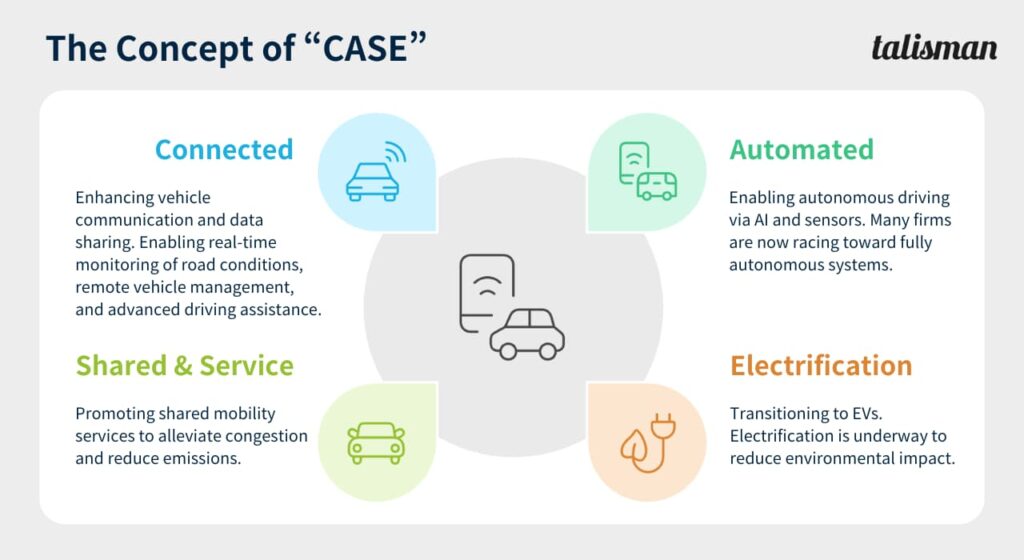
The global automotive industry is a massive market, with sales reaching approximately 95.31 million units in 2024 (*1) and a total market size of about 400 trillion yen. Currently, the industry is defined by the concept of CASE (Connected, Automated/Autonomous, Shared & Service, Electrification).
Sales of electric vehicles (EVs) continue to rise. According to the International Energy Agency (IEA) outlook, approximately 17 million EVs and other electric vehicles are projected to be sold in 2024, accounting for a full 20% of global new vehicle sales (*2). This trend is also essential for achieving carbon neutrality (balancing greenhouse gas emissions, including carbon dioxide, with absorption). Furthermore, autonomous driving technology is considered one of the most critical technologies shaping the future of the automotive industry. It holds significant promise for accident prevention, improving traffic efficiency, and addressing labor shortages. Automakers are aiming to provide new mobility services and build sustainable transportation systems, driving continuous evolution across the entire industry.
*1 OICA「Global Sales Statistics 2019 – 2023」
*2 IEA Global EV Outlook 2024
Autonomous Driving Levels and Key Technologies
Autonomous driving is classified into six levels, ranging from Level 0 (manual driving) to Level 5 (full automation). In Japan, Level 2 and Level 3 technologies have been commercialized. These technologies partially automate driving under specific conditions, allowing drivers to relinquish control in certain scenarios. For example, at Level 3, autonomous driving on highways is possible, enabling hands-off operations under defined conditions.
| Levels of Autonomous Driving | Driving Entity | Overview |
|---|---|---|
| 0 – No driving automation | Driver | The driver is responsible for all driving tasks. Traditional vehicles without ADAS (Advanced Driver Assistance Systems) |
| 1 – Driver assistance | Driver | The system controls the vehicle either forward/backward or left/right (either accelerator/brake operation or steering operation is partially automated). Examples include automatic braking, following the vehicle in front (ACC: Adaptive Cruise Control), and staying within the lane (LKAS: Lane Keep Assist System). |
| 2 – Partially automated driving | Driver | The system performs the dynamic driving task of controlling vehicle motion in both longitudinal and lateral directions (accelerating, braking and steering) within a limited area. |
| 3 – Conditional Driving Automation | system | The system performs all driving tasks under certain conditions. During autonomous driving, the system takes over as the driver, but the driver must respond appropriately to requests for intervention from the system. |
| 4 – Highly automated driving | system | The system performs all driving tasks, and responds to situations where it is difficult to continue operation in a limited area. |
| 5 – Fully autonomous | system | The system constantly performs all driving tasks and takes over all driving operations. |
For a car to drive autonomously, it must replicate three critical human actions: perception, decision-making, and control. Below, we highlight some of the key technologies enabling autonomous driving.
| Cognition | LiDAR | This technology allows vehicles to detect surrounding objects and terrain with high accuracy. It measures the time it takes for laser light to hit an object and bounce back, and is used to measure the distance and direction to an object and identify other vehicles and obstacles. |
|---|---|---|
| Cognition | HD Maps | High-precision 3D map data is essential for autonomous vehicles to determine their exact position down to the centimeter, and to make decisions based on traffic rules and terrain. |
| Judgment | AI (Artificial Intelligence) | AI technology plays a vital role in enabling autonomous vehicles to recognize their environment and make decisions. Deep learning and data analysis allow vehicles to understand their surroundings and make optimal driving decisions. |
| Operation | Software Development | Software is the core component that enables safe driving of a vehicle. It is the program that processes the data obtained from each sensor and controls the movement of the vehicle. |
Global Trends in Autonomous Driving (Technology Trends and Regulations)
As autonomous driving technologies evolve, a global race for innovation is underway, moving in tandem with the development of new regulations. Furthermore, the synergy between electrification and automation is paving the way for sustainable transport and smarter infrastructure. Significant shifts are expected across the market, particularly in improving road safety, streamlining logistics, and reimagining how cities manage traffic.
- USA
Alphabet’s Waymo has continued its steady expansion, launching its Level 4 autonomous ride-hailing service to the general public in parts of Los Angeles in November 2024, following its success in San Francisco and Phoenix. By 2025, the company further extended its footprint to five North American cities, adding Austin and Atlanta to its network, and most recently initiated services in Miami in January 2026.
In contrast, Tesla—which approaches autonomous driving through ‘End-to-End AI’ (E2E AI)—unveiled its prototype for a Level 4 autonomous EV taxi in October 2024. With a target production date of April 2026, the company aims to make the vehicle available for under $30,000 (approximately ¥4.7 million). Furthermore, Tesla launched its own robotaxi service in Austin, Texas, in June 2025, and has been progressively expanding its service areas since then. - China
In China, where autonomous driving services are becoming more deeply integrated than in any other nation, companies such as WeRide, the tech giant Baidu, and Pony.ai are actively deploying Level 4 robotaxi services. These firms have also secured testing and operational permits abroad, extending their reach into markets including the United States, the UAE, Singapore, and France.
Simultaneously, cross-industry entrants like Huawei and Xiaomi have redefined the domestic passenger vehicle market by offering sophisticated Advanced Driver Assistance Systems (ADAS). These technologies are rapidly becoming standard features, thereby accelerating the industry’s transition toward Software-Defined Vehicles (SDVs). Furthermore, a landmark regulation enacted in Beijing in April 2025 has authorized private vehicles equipped with Level 3 autonomy or higher to operate on public roads—a move widely expected to catalyze further technical innovation and product development. - Japan
In Japan, major automakers like Toyota and Honda are aggressively advancing autonomous technologies. Toyota is aiming for the commercial deployment of self-driving services in urban areas as part of its ‘Mobility as a Service’ (MaaS) vision. Meanwhile, Honda established technical leadership by releasing the Legend, the world’s first production vehicle equipped with Level 3 autonomy (though its production concluded in 2022). Regarding ride-hailing services, the aforementioned Waymo partnered with Nihon Kotsu and GO to begin testing autonomous vehicles in Tokyo in April 2025 as part of an international road trip.
From 2026 onward, next-generation vehicles powered by proprietary ‘Vehicle OS’ and ADAS platforms—such as Toyota’s Arene and Sony-Honda’s AFEELA Intelligent Drive—will steadily enter the market. This marks a definitive shift toward Software-Defined Vehicles (SDVs), where software defines performance and safety is continuously enhanced post-purchase via Over-the-Air (OTA) updates.
In the logistics sector, as of January 2026, autonomous truck testing utilizing Vehicle-to-Everything (V2X) communication is underway on specific sections of the Shin-Tomei Expressway (e.g., between Surugawan-Numazu and Hamamatsu). This automation of ‘long-haul trunk transport’ is highly anticipated as a solution to the nation’s severe driver shortage.
For last-mile transport, a Level 4 medium-sized bus service supported by the government began commercial operations in Kashiwa, Chiba, in January 2026. This service, where the system manages all driving tasks under specific conditions, serves as a shuttle for students, staff, and visitors around the university campus. Furthermore, Iyotetsu Bus in Matsuyama, Ehime, launched Japan’s first driverless Level 4 commercial bus service in January 2026. Utilizing a ‘cockpit-less’ EV bus developed by China’s WeRide, the route navigates a complex city environment of 500,000 residents and includes the world’s first autonomous crossing of a railroad junction.
Additionally, Woven City—Toyota’s ‘living laboratory’ for autonomous driving, AI, and robotics in Susono, Shizuoka—officially launched its first phase on September 25, 2025. With an initial population of approximately 360 residents, the city has begun real-world demonstrations, drawing global attention as a blueprint for future societies.
The Advance of Autonomous Technology and Warnings Regarding Safety
On March 29, 2025, a tragic accident involving a Xiaomi SU7 electric vehicle in Anhui Province, China, claimed the lives of three university students, reigniting intense debate over the safety of autonomous driving assistance systems. The vehicle was operating in “Smart Assist” mode on a highway when it detected an obstacle; however, despite issuing a warning, the system failed to prevent the collision. This incident follows several other fatal accidents in the United States, further underscoring the risks associated with such technologies.
While autonomous driving offers immense convenience and efficiency, it simultaneously brings critical safety and ethical challenges to the forefront. These accidents serve as a stark reminder that the technology remains in a developmental stage, requiring coordinated efforts from corporations, regulatory bodies, and users alike to enhance safety standards. It is essential to maintain the perspective that technology is not a total replacement for human judgment but a tool to augment it, ensuring that “safety first” remains the guiding principle for its adoption.
Japan’s Mobility DX Strategy
Amidst the intensifying global competition for technical dominance, Japan’s Ministry of Economy, Trade and Industry (METI) spearheaded the formulation of the “Mobility DX Strategy” in May 2024, following extensive public-private deliberations. The primary objective of this strategy is to secure a 30% global market share for Japanese-brand Software-Defined Vehicles (SDVs) by 2035.
In June 2025, the strategy was revised to address rapid shifts in the external environment, including the accelerated race to implement AI-powered autonomous driving and heightened geopolitical risks. Under this framework, SDVs are defined as vehicles whose hardware functions and performance can be enhanced or expanded post-purchase through software updates, facilitated by bidirectional communication between the vehicle and external networks. To achieve its 2035 target, the Japanese government is fostering cross-industry collaboration, focusing on the development of shared vehicle OS architectures and the cultivation of specialized software talent.
The Autonomous Driving and MaaS Industry Map
The image above is an industry map curated by our editorial team, categorizing key players within the autonomous driving and MaaS (Mobility as a Service) sectors by segment.
The autonomous driving and MaaS industry is undergoing a profound structural evolution. It is shifting away from the traditional “pyramid structure,” where original equipment manufacturers (OEMs) sat at the apex, toward a “horizontal, specialized ecosystem” centered on software, data, and infrastructure.
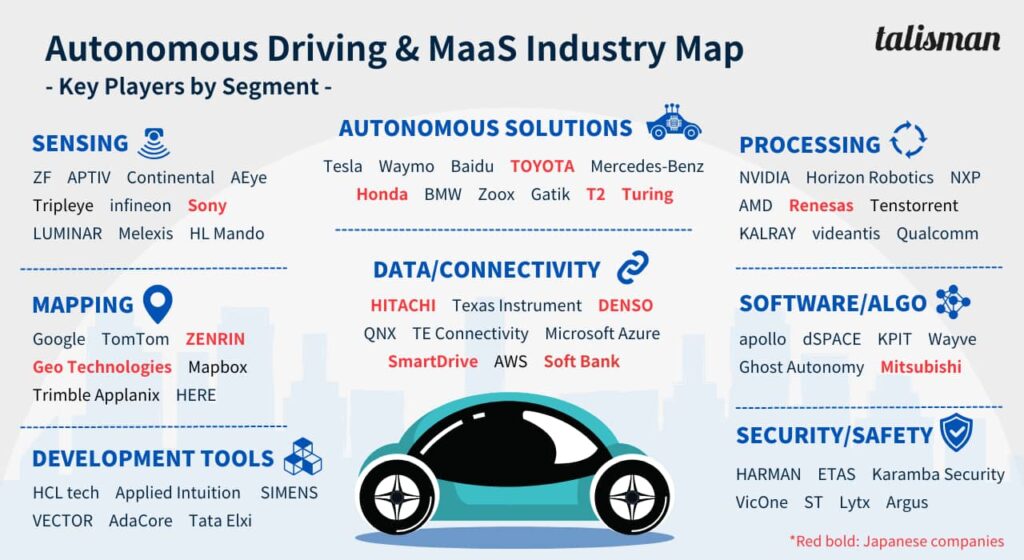
We will introduce the major players and noteworthy companies as of 2026, while explaining current trends according to the segments on the map.
AUTONOMOUS SOLUTIONS (Vehicle & System Integration)
This layer involves providing the vehicles themselves or integrated autonomous driving systems as a whole. Trends include Tesla’s aim to begin production of its “driverless robotaxi” in 2026, and the continued expansion of Waymo’s unmanned services across major cities. Domestically, in addition to Honda and Toyota, open-source-driven players such as TIER IV are spearheading the implementation of Level 4 autonomy.
🌟 Key Players and Notable Companies
- Turing Inc.
Established in August 2021, Turing has identified itself as an “automaker” from the very beginning. CEO Yamamoto has explicitly stated his goal to “build a finished vehicle manufacturer that overtakes Tesla,” setting the company’s mission as “We Overtake Tesla.” Its goal of mass-producing 10,000 in-house fully autonomous EVs by 2030 is also particularly noteworthy. - Tesla
Tesla has continued the evolution of its FSD (Full Self-Driving) technology and has commenced mass production of its dedicated robotaxi vehicle.
PROCESSING (Semiconductors & Computational Processing)
This layer is responsible for the semiconductors and hardware that perform the computational processing, serving as the “brain” of autonomous driving. At CES 2026 in January, NVIDIA unveiled a next-generation AI platform equipped with “Reasoning” capabilities. With the improvement in processing power, it is becoming standard to equip vehicles with AI capable of making human-like judgments even in complex situations. There have also been shifts among players, such as TOSHIBA effectively fading out from general-purpose image recognition processors like the Visconti series, and Intel handing over its primary development focus to its subsidiary Mobileye while shifting its main business toward manufacturing (foundry).
🌟 Key Players and Notable Companies
- NVIDIA
Its automotive SoC, “DRIVE Thor,” has become the de facto standard for Level 4 vehicles. - Qualcomm
Expanding rapidly with the “Snapdragon Digital Chassis,” which integrates 5G communication and computational processing.
SENSING (Sensor Technology)
This layer fulfills the role of the “eyes” that perceive the vehicle’s surroundings. In addition to LiDAR, which generates high-precision 3D maps, “vision-based” technologies—which perform advanced recognition using only cameras—have evolved further. Achieving a balance between cost reduction and accuracy is the key to the widespread adoption of mass-produced SDVs. While many companies previously entered the LiDAR development market, as of 2026, Pioneer and Bosch have withdrawn from in-house development. Currently, the market is consolidating toward players like Luminar, which has succeeded in mass production, Sony, which leverages its proprietary image sensors as a primary strength, and integrators such as Continental and ZF that control and integrate sensor data. Behind the scenes, companies like Bosch and Pioneer have withdrawn from the independent development of LiDAR due to intensifying cost competition.
🌟 Key Players and Notable Companies
- Sony
Leading the field with “intelligent sensors” that feature built-in AI chips to complete object detection within the sensor itself. - Luminar
Emerging as the winner in the LiDAR market with a track record of installation in mass-produced vehicles from companies like Volvo.
DATA/CONNECTIVITY (Communication & Cloud)
This layer consists of the infrastructure and connected technologies that support data communication between the vehicle and the outside world, as well as within the vehicle. The introduction of “V2X” (Vehicle-to-Everything) technology, which enables vehicles to communicate with all types of entities, is accelerating. In Japan, in particular, infrastructure-coordinated implementation is progressing, such as autonomous truck demonstrations utilizing V2N (Vehicle-to-Network) communication on the Shin-Tomei Expressway.
🌟 Key Players and Notable Companies
- SmartDrive Inc.
Since its founding in 2013, SmartDrive has held the vision of “driving the evolution of mobility.” The company collects and analyzes a wide variety of sensor data related to mobile objects and deploys this information through an open platform. It has an extensive track record of implementations and partnerships with major corporations and successfully listed on the Tokyo Stock Exchange (TSE) Growth Market in December 2022. - BlackBerry QNX
As of 2026, it is the de facto standard for safety-critical control operating systems.
MAPPING (High-Precision Maps)
This layer consists of the “High-Definition Maps (HD Maps)” essential for safe driving. The HD maps provided by companies such as Dynamic Map Platform have seen progress in international standardization, with their adoption expanding into North American and Middle Eastern markets in 2026. Furthermore, AI-driven real-time map updating technology has reached the practical implementation phase.
🌟 Key Players and Notable Companies
- Mapbox
Growing rapidly as a “Map SDK for the SDV era” that allows developers to freely customize user interfaces.
SOFTWARE/ALGO (Software & Algorithms)
This layer consists of the algorithms and middleware used for perception, judgment, and operation. In 2026, the social implementation of “End-to-End (E2E) AI” has entered full-scale operation. Integrated AI models that manage everything from input to output have dramatically improved the ability to handle “edge cases” that conventional rule-based systems could not fully address.
🌟 Key Players and Notable Companies
- dSPACE
As software development becomes increasingly complex, demand for “HIL (Hardware-in-the-Loop)” simulators—which conduct tests in virtual environments—has surged. As of 2026, these simulators have been implemented at the SDV development centers of nearly all OEMs.
SECURITY/SAFETY
This is an extremely critical layer for ensuring functional safety and protection against cyberattacks. Within the World Forum for Harmonization of Vehicle Regulations (WP.29) of the United Nations, more advanced international standards for autonomous vehicles are expected to be established by June 2026. Consequently, cybersecurity measures from the design stage and the assurance of safety for software updates have become increasingly stringent.
🌟 Key Players and Notable Companies
- ETAS
As a subsidiary of Bosch, ETAS has become the leading player in UN-R155/156 compliance. As conformity to international regulations becomes mandatory, the company provides a comprehensive package of security monitoring (VSOC) from design to operation by integrating technology from its ESCRYPT brand.
DEVELOPMENT TOOLS
This layer consists of a suite of tools that enable efficient development and simulation. AI-powered tools designed to simplify the development of Software-Defined Vehicles (SDVs) have been announced. Through digital twin technology, which conducts vast amounts of driving tests in virtual space, a development style that ensures safety without waiting for public road verification has become firmly established.
🌟 Key Players and Notable Companies
- Siemens
At CES 2026 in January, Siemens announced its “Industrial AI” vision in partnership with NVIDIA and Microsoft. Its “PAVE360” platform, which allows for the complete virtualization and verification of a vehicle’s performance before it is even built, has become a standard tool for SDV development. - Vector
As of 2026, Vector maintains its position as an “essential tool” for engineers worldwide in simulating in-vehicle communications and developing AUTOSAR-compliant software.
The following is a list of noteworthy companies related to autonomous driving technology. You can also search by category, making it a useful resource for information gathering and research.
*Compiled by our editorial team based on the autonomous driving client list (including candidates) of the Talisman DeepTech specialist team.
| 分類 | 企業名 / Website | 国 |
|---|---|---|
| AUTONOMOUS SOLUTIONS | Audi |  |
| AUTONOMOUS SOLUTIONS | Ford |  |
| AUTONOMOUS SOLUTIONS | Hyundai |  |
| AUTONOMOUS SOLUTIONS | KIA motors | |
| AUTONOMOUS SOLUTIONS | Stellantis |  |
| AUTONOMOUS SOLUTIONS | Volkswagen | |
| AUTONOMOUS SOLUTIONS | Toyota |  |
| AUTONOMOUS SOLUTIONS | Nissan | |
| AUTONOMOUS SOLUTIONS | BAIC |  |
| AUTONOMOUS SOLUTIONS | Mercedes-Benz | |
| AUTONOMOUS SOLUTIONS | BMW | |
| AUTONOMOUS SOLUTIONS | GM | |
| AUTONOMOUS SOLUTIONS | Honda | |
| AUTONOMOUS SOLUTIONS | Jaguar |  |
| AUTONOMOUS SOLUTIONS | GEELY | |
| AUTONOMOUS SOLUTIONS | Renault |  |
| AUTONOMOUS SOLUTIONS | Tesla | |
| AUTONOMOUS SOLUTIONS | Volvo |  |
| AUTONOMOUS SOLUTIONS | SAIC | |
| AUTONOMOUS SOLUTIONS | CHANGAN | |
| AUTONOMOUS SOLUTIONS | CHERY | |
| AUTONOMOUS SOLUTIONS | Waymo | |
| AUTONOMOUS SOLUTIONS | LYFT | |
| AUTONOMOUS SOLUTIONS | Navya Mobility(Macnica Group) | |
| AUTONOMOUS SOLUTIONS | Torc Robotics | |
| AUTONOMOUS SOLUTIONS | SD advanced engineering | |
| AUTONOMOUS SOLUTIONS | Uber | |
| AUTONOMOUS SOLUTIONS | Easy mile | |
| AUTONOMOUS SOLUTIONS | 2get there(ZF Group) | |
| AUTONOMOUS SOLUTIONS | Baidu 百度 | |
| AUTONOMOUS SOLUTIONS | Zoox | |
| AUTONOMOUS SOLUTIONS | Nauto | |
| AUTONOMOUS SOLUTIONS | May mobility | |
| AUTONOMOUS SOLUTIONS | NXP | |
| AUTONOMOUS SOLUTIONS | ZF | |
| AUTONOMOUS SOLUTIONS | NVIDIA | |
| AUTONOMOUS SOLUTIONS | MAGNA |  |
| AUTONOMOUS SOLUTIONS | Continental | |
| AUTONOMOUS SOLUTIONS | BOSCH | |
| AUTONOMOUS SOLUTIONS | Aptiv | |
| AUTONOMOUS SOLUTIONS | HITACHI | |
| AUTONOMOUS SOLUTIONS | Renesas | |
| AUTONOMOUS SOLUTIONS | SAMSUNG | |
| AUTONOMOUS SOLUTIONS | intel | |
| AUTONOMOUS SOLUTIONS | Visteon | |
| AUTONOMOUS SOLUTIONS | ZMP | |
| AUTONOMOUS SOLUTIONS | RoboCV |  |
| AUTONOMOUS SOLUTIONS | Turing | |
| PROCESSING | Renesas | |
| PROCESSING | NVIDIA | |
| PROCESSING | Mobileye |  |
| PROCESSING | KALRAY | |
| PROCESSING | Synopsys | |
| PROCESSING | NXP | |
| PROCESSING | TOSHIBA | |
| PROCESSING | CEVA | |
| PROCESSING | cadence | |
| PROCESSING | Imagination Technologies | |
| PROCESSING | Analog Devices | |
| PROCESSING | AMD | |
| PROCESSING | intel | |
| PROCESSING | arm | |
| PROCESSING | Outsight | |
| PROCESSING | ST |  |
| PROCESSING | videantis | |
| PROCESSING | Texas Instrument | |
| PROCESSING | MARVELL | |
| PROCESSING | Graphcore | |
| PROCESSING | Qualcomm | |
| PROCESSING | aiMotive(Stellantis Group) |  |
| SENSING | BOSCH | |
| SENSING | Texas Instrument | |
| SENSING | ZF | |
| SENSING | Mitsubishi | |
| SENSING | Continental | |
| SENSING | microvision | |
| SENSING | Valeo | |
| SENSING | XenomatiX |  |
| SENSING | arbe | |
| SENSING | TOSHIBA | |
| SENSING | HITACHI | |
| SENSING | Luminar | |
| SENSING | Autoliv | |
| SENSING | KOSTAL | |
| SENSING | HYUNDAI MOBIS | |
| SENSING | Aptiv | |
| SENSING | INNOVIZ | |
| SENSING | Pioneer | |
| SENSING | DENSO | |
| SENSING | robosense | |
| SENSING | LG Innotek | |
| SENSING | LYNRED | |
| SENSING | Panasonic AUTOMOTIVE(2027年モビテラに社名変更予定) | |
| SENSING | HARMAN | |
| SENSING | Denso ten | |
| SENSING | MAGNA | |
| SENSING | OUSTER | |
| SENSING | TetraVue | |
| SENSING | Aeye | |
| SENSING | Teledyne FLIR | |
| SENSING | FORVIA HELLA | |
| SENSING | novatel | |
| SENSING | Infineon Technologies | |
| SENSING | ECHODYNE | |
| SENSING | HL Mando | |
| SENSING | Leddar Tech | |
| SENSING | Trimble Applanix | |
| SENSING | NXP | |
| SENSING | Trimble | |
| SENSING | U-blox | |
| SENSING | Honeywell | |
| SENSING | SBG SYSTEMS | |
| SENSING | OMNIVISION | |
| SENSING | OSRAM | |
| SENSING | SIMENS | |
| SENSING | Melexis | |
| SENSING | Lumentum | |
| SENSING | SONY | |
| DATA/CONNECTIVITY | HITACHI | |
| DATA/CONNECTIVITY | Renesas | |
| DATA/CONNECTIVITY | NXP | |
| DATA/CONNECTIVITY | Continental | |
| DATA/CONNECTIVITY | Texas Instrument | |
| DATA/CONNECTIVITY | BlackBerry QNX | |
| DATA/CONNECTIVITY | BOSCH | |
| DATA/CONNECTIVITY | MARVELL | |
| DATA/CONNECTIVITY | Analog Devices | |
| DATA/CONNECTIVITY | Semtech | |
| DATA/CONNECTIVITY | intel | |
| DATA/CONNECTIVITY | Realtek |  |
| DATA/CONNECTIVITY | Cohda Wireless |  |
| DATA/CONNECTIVITY | BROADCOM | |
| DATA/CONNECTIVITY | TTTech |  |
| DATA/CONNECTIVITY | TE Connectivity | |
| DATA/CONNECTIVITY | Valens | |
| DATA/CONNECTIVITY | Elektrobit | |
| DATA/CONNECTIVITY | microchip | |
| DATA/CONNECTIVITY | DENSO | |
| DATA/CONNECTIVITY | HARMAN | |
| DATA/CONNECTIVITY | Infineon Technologies | |
| DATA/CONNECTIVITY | SIMENS EDA | |
| DATA/CONNECTIVITY | molex | |
| DATA/CONNECTIVITY | SmartDrive | |
| DATA/CONNECTIVITY | GreenRoad | |
| DATA/CONNECTIVITY | W-Locate |  |
| DATA/CONNECTIVITY | Vnomics | |
| DATA/CONNECTIVITY | ZONAR | |
| DATA/CONNECTIVITY | Peloton Technology | |
| DATA/CONNECTIVITY | Car IQ |  |
| DATA/CONNECTIVITY | IMS | |
| DATA/CONNECTIVITY | metromile | |
| DATA/CONNECTIVITY | Zubie | |
| DATA/CONNECTIVITY | Vinli | |
| DATA/CONNECTIVITY | MOJIO | |
| DATA/CONNECTIVITY | Airbiquity | |
| DATA/CONNECTIVITY | Automile | |
| MAPPING | TomTom | |
| MAPPING | here | |
| MAPPING | |
|
| MAPPING | NavInfo | |
| MAPPING | Sanborn | |
| MAPPING | Dynamic Map Platform | |
| MAPPING | GeoDigital | |
| MAPPING | Geo Technologies | |
| MAPPING | Civil Maps | |
| SOFTWARE/ALGO | Baidu 百度 | |
| SOFTWARE/ALGO | Mapbox | |
| SOFTWARE/ALGO | ZENRIN | |
| SOFTWARE/ALGO | Trimble Applanix | |
| SOFTWARE/ALGO | apollo | |
| SOFTWARE/ALGO | Elektrobit | |
| SOFTWARE/ALGO | dSPACE | |
| SOFTWARE/ALGO | NVIDIA | |
| SOFTWARE/ALGO | AI motive | |
| SOFTWARE/ALGO | Five AI | |
| SOFTWARE/ALGO | Mitsubishi | |
| SOFTWARE/ALGO | oxa | |
| SOFTWARE/ALGO | Outsight | |
| SOFTWARE/ALGO | KPIT | |
| SOFTWARE/ALGO | BASELABS | |
| SOFTWARE/ALGO | Luxoft | |
| SOFTWARE/ALGO | Neusoft | |
| SOFTWARE/ALGO | Nauto | |
| SOFTWARE/ALGO | Mobileye | |
| SOFTWARE/ALGO | HCL tech | |
| SOFTWARE/ALGO | AURORA | |
| SECURITY/SAFETY | HARMAN | |
| SECURITY/SAFETY | Karamba Security | |
| SECURITY/SAFETY | BOSCH | |
| SECURITY/SAFETY | SIMENS EDA | |
| SECURITY/SAFETY | Aptiv | |
| SECURITY/SAFETY | Continental | |
| SECURITY/SAFETY | Wind River | |
| SECURITY/SAFETY | HITACHI | |
| SECURITY/SAFETY | NXP | |
| SECURITY/SAFETY | IBM | |
| SECURITY/SAFETY | verizon | |
| SECURITY/SAFETY | Renesas | |
| SECURITY/SAFETY | PlaxidityX | |
| SECURITY/SAFETY | BlackBerry QNX | |
| SECURITY/SAFETY | intel | |
| SECURITY/SAFETY | DENSO | |
| SECURITY/SAFETY | ETAS | |
| SECURITY/SAFETY | Green Hills Software | |
| SECURITY/SAFETY | LYNX | |
| SECURITY/SAFETY | secunet | |
| SECURITY/SAFETY | irdeto | |
| SECURITY/SAFETY | Synopsys | |
| SECURITY/SAFETY | ST | |
| SECURITY/SAFETY | KPIT | |
| SECURITY/SAFETY | Rambus | |
| SECURITY/SAFETY | Texas Instrument | |
| SECURITY/SAFETY | Infineon Technologies | |
| SECURITY/SAFETY | VECTOR | |
| SECURITY/SAFETY | CAMBRIDGE MOBILE TELEMATICS | |
| SECURITY/SAFETY | Lytx | |
| DEVELOPMENT TOOLS | HCL tech | |
| DEVELOPMENT TOOLS | Ansys | |
| DEVELOPMENT TOOLS | Polysync | |
| DEVELOPMENT TOOLS | ESI | |
| DEVELOPMENT TOOLS | IAR | |
| DEVELOPMENT TOOLS | Dataspeed Inc. | |
| DEVELOPMENT TOOLS | INTEMPORA | |
| DEVELOPMENT TOOLS | LDRA | |
| DEVELOPMENT TOOLS | Mechanical Simulation | |
| DEVELOPMENT TOOLS | MathWorks | |
| DEVELOPMENT TOOLS | Synopsys | |
| DEVELOPMENT TOOLS | TTTech | |
| DEVELOPMENT TOOLS | dSPACE | |
| DEVELOPMENT TOOLS | IAV | |
| DEVELOPMENT TOOLS | ETAS | |
| DEVELOPMENT TOOLS | Elektrobit | |
| DEVELOPMENT TOOLS | AdaCore | |
| DEVELOPMENT TOOLS | KPIT | |
| DEVELOPMENT TOOLS | SIMENS | |
| DEVELOPMENT TOOLS | VECTOR | |
| DEVELOPMENT TOOLS | b-plus | |
| DEVELOPMENT TOOLS | BASELABS | |
| DEVELOPMENT TOOLS | IPG | |
| DEVELOPMENT TOOLS | SIMENS EDA | |
| DEVELOPMENT TOOLS | AMD | |
| DEVELOPMENT TOOLS | Maplesoft | |
| DEVELOPMENT TOOLS | AutonomouStuff | |
| DEVELOPMENT TOOLS | Tata Elxsi | |
The State of the Job Market in the Automotive Industry
As stated in documents from the Ministry of Economy, Trade and Industry (METI), the greatest obstacle to the advancement of SDVs is the “overwhelming shortage of software talent.” In this era of profound transformation, the demand for IT professionals in the automotive sector is skyrocketing. This section explains the current recruitment landscape and the ideal candidate profiles sought by the industry.
Overall Recruitment Trends
Software-related job openings are surging across the automotive industry. This is driven by the rise of Software-Defined Vehicles (SDVs), where software now dictates a vehicle’s core functions and performance. In particular, the proliferation of 5G technology has heightened recruitment needs in the “Connected” domain, including autonomous driving systems, vehicle networking, and OTA (Over-The-Air) software updates and data collection. This trend has also spread to in-vehicle systems and cybersecurity sectors, leading to a significant increase in vacancies over the past few years.
High-Growth Recruitment Areas
Specific fields seeing an increase in software-related roles include autonomous driving technology, connected systems, cybersecurity, and MaaS (Mobility as a Service). Recruitment is progressing across a wide range of roles; notably, the MaaS sector shows a high volume of openings for data analysis and mobile app development.
For SEs (System Engineers) and infrastructure engineers, development and operational skills are highly valued, making these roles relatively accessible even for those with no prior experience in the automotive industry. On the other hand, for embedded engineers, prior experience in the automotive sector is often a mandatory requirement, making lateral moves within the industry more common. In the development of ADAS (Advanced Driver Assistance Systems) and AD (Autonomous Driving), Model-Based Development (MBD) using simulations has become mainstream. Because MBD offers numerous advantages—such as the ability to test far more scenarios than traditional physical vehicle testing—engineers with skills in model and simulation development are in high demand.
Ideal Candidate Profiles and Skills
- Focus on Professional Experience Over Academic Background
The automotive industry as a whole tends to prioritize professional experience over academic credentials. Even in actual job postings, educational requirements are often limited to “University Graduate / Science or Engineering Major.” When changing careers, candidates should focus their application documents and interview preparation on the experience and skills gained in their previous roles, regardless of the industry. - A High Concentration of “Tech Enthusiasts”?
Since automotive development is rooted in “monozukuri” (craftsmanship), many professionals—particularly embedded engineers—possess a strong passion for technology and a craftsman-like spirit. Creativity and an inquisitive mind are vital factors. Candidates are highly valued for their proactive approach to learning new technologies and their commitment to continuous technical exploration.
In the Field of Autonomous Driving Technology
As systems become increasingly sophisticated, professionals with the following specialized knowledge and skills are highly valued in the autonomous driving sector:
- ADAS & Recognition Algorithms (Formerly DAS Camera Technology):
This refers to environmental perception technology using sensors such as cameras, LiDAR, and radar. In recent years, the focus has shifted beyond simple detection toward object recognition and semantic segmentation (pixel-level identification) using AI (Machine Learning/Deep Learning). Engineers experienced in designing these data processing algorithms and implementing them on SoC (System on Chip) are prized as the cornerstones of development. - AUTomotive Open System ARchitecture (AUTOSAR) Classic / Adaptive:
These are the global standardized platforms for automotive software. In addition to “Classic” AUTOSAR, which manages traditional control functions, knowledge of “Adaptive” AUTOSAR—which supports the advanced computational needs of autonomous driving—has become an essential skill in current SDV (Software-Defined Vehicle) development. Engineers capable of ensuring development efficiency and reliability through architecture standardization are highly regarded in global projects. - Model-Based Development (MATLAB / Simulink / Stateflow):
This is the essential suite of tools for modeling and simulating complex control logic. In autonomous driving development, where physical testing can be difficult, skills in MBD (Model-Based Development)—which verify and optimize algorithms in virtual environments—are in high demand as they directly lead to shorter development cycles and improved quality. - Integrated ECU (Electronic Control Unit) & Zone Architecture:
ECUs are electronic control units responsible for various control functions within the vehicle. Autonomous driving systems require automated control of the entire vehicle, including braking, steering, and the engine; therefore, those with a deep understanding of ECUs are welcomed in development roles. As of 2026, the industry is transitioning from individual ECUs to “Integrated ECUs (HPC)” with powerful computational capabilities and “Zone Architecture” to streamline wiring. Professionals who can look beyond just braking and steering to oversee the entire system configuration and design the optimal resource allocation between hardware and software are exceptionally well-received.
Individuals proficient in these technologies who also possess perspectives on cybersecurity and functional safety (ISO 26262) will see their market value soar as leaders supporting the safety and evolution of next-generation mobility.
Newly Required Modern Skills
To be considered “job-ready” in the 2026 career-change market, the following skill sets are key:
- Rust:
Adoption of Rust is rapidly expanding as a safe and high-speed control language to replace C++. - End-to-End AI:
Expertise in next-generation AI that learns everything from sensor input to driving decisions in an integrated manner. - Model-Based Development (MATLAB / Simulink / Stateflow):
This is the essential suite of tools for modeling and simulating complex control logic. In autonomous driving development, where physical testing can be difficult, skills in MBD (Model-Based Development)—which verify and optimize algorithms in virtual environments—are in high demand as they directly lead to shorter development cycles and improved quality. - Cybersecurity (WP.29):
Knowledge of “Security by Design,” which incorporates hacking-prevention measures from the initial design phase based on international regulations (UN-R155/156).
Tips for Changing Careers to the Autonomous Driving and MaaS Industry
1. How to Find Job Opportunities
(1) Utilize Major Job Boards
- LinkedIn: > LinkedIn is a powerful tool that allows you to connect directly with automotive companies and hiring managers through a global network. By keeping your profile up to date and highlighting relevant skills and experience, you can attract scouts from agents and recruiters.
- doda: > doda is a comprehensive job search and career-change site widely used in Japan. Perhaps because the number of registered candidates is small relative to the high hiring demand in automotive sectors, it is not uncommon for users to receive over 100 scout messages in a single month.
(2) Leverage Recruitment Agencies and Scout Services
- The Benefits of Using Recruitment Agencies:
Recruitment agents specializing in the automotive industry are likely to provide access to “hidden” (unlisted) job opportunities, and many scouts are sent via these agencies. Furthermore, they offer support for polishing your application documents and preparing for interviews, allowing even first-time career-changers to proceed with confidence.Talisman has a consulting team specializing in the automotive industry. We possess particular strength in the embedded systems sector and can provide introductions to a wide range of companies.
Prakash - How to Get Scouted:
Regardless of the platform, there are a few tricks to receiving high-quality scout offers. No matter how impressive your skills or experience may be, recruiters cannot grasp your value from a bare-bones profile that only lists your job title. You will be much more likely to catch the eye of corporate recruiters if you describe your technical skills and experience in development projects in detail to make your profile attractive.
2. Interview Preparation Specific to the Automotive Industry
(1) Key Points for the Interview
- Demonstrating Achievements with Specifics
In automotive industry interviews, particularly for technical roles, it is crucial to demonstrate your experience and achievements concretely. Interviewers will ask for details regarding past projects and responsibilities to evaluate your technical proficiency. It is effective to explain your specific results, your role within the project, the technologies and tools used, and how you handled challenges, using data and concrete examples where possible. - Understanding Industry Knowledge and Trends
As the automotive industry is undergoing rapid technological innovation—such as CASE—you must demonstrate that you are well-versed in the latest industry trends and technical advancements. During the interview, you may be asked for your perspective on topics such as “How are you responding to current industry trends?” or “How will the progress of autonomous driving and electrification impact the industry in the future?” Showing your knowledge and articulating how you can contribute with a vision for the industry’s future will significantly enhance your impression.
(2) Common Interview Questions
Interviews in the automotive industry frequently include questions that probe your industry-specific expertise and practical experience. Below are examples of commonly asked questions:
Questions Regarding Technical Experience
- “Please tell us about the vehicle design or development projects you have been involved in. What challenges did you face, and how did you address them?”
- “What specific technologies or tools have you used in mechanical design or electronic control systems for automobiles?”
- “Could you explain your experience in developing electrification or autonomous driving technologies in detail?”
Questions Regarding Industry Experience
- “Looking back at your career in the automotive industry, which project do you consider your greatest achievement?”
- “How do you stay updated on automotive industry trends and recent technological advancements?”
- “Have you ever participated in cross-departmental collaboration in your previous roles? How did that experience contribute to the project’s success?”
Support Provided by Talisman
To successfully navigate a career change within the automotive industry, we highly recommend seeking professional support. At Talisman, we provide comprehensive services tailored to each candidate’s specific needs. Below are our key support areas:
1. Resume Review and Application Refinement
- Identifying Aspirations and Requirements:
First, we conduct a detailed interview to understand your specific career goals, preferred locations, and target positions. By confirming your desired technical fields and career path, we identify the companies and roles that offer the best fit. This process ensures a high level of matching precision that is often difficult to achieve through direct applications. - Polishing Your Resume:
We review your application documents before submission and provide advice as needed. In cases where bilingual resumes are required, Talisman’s team of bilingual and international consultants can assist with resumes in Japanese, English, and Chinese.
2. Interview Preparation and Follow-up Support
- Alleviating Concerns and Providing Mock Interviews:
Before your actual interview, we address any anxieties or questions you may have to ensure you can proceed with confidence. We provide guidance on how to answer specific questions and how to prepare for technical inquiries unique to the automotive industry. Additionally, we provide prompt feedback after each interview, confirming additional information or areas for improvement for the next step. - Bridging the Gap Between Japanese and International Interview Styles:
For candidates from overseas, we carefully explain the differences in Japanese interview styles and corporate culture. We also handle the coordination of interview schedules based on the specific flow of each position and the company’s preferences. Acting as your point of contact, we ensure smooth communication until an offer is secured, allowing you to move through the process without stress.
3. Coordination Across Multiple Selection Processes
- Schedule Management and Information Sharing:
When a candidate is interviewing with multiple companies, we track the progress and schedules of each one to ensure they proceed at the optimal timing. One of the significant advantages of using an agency is the ability to manage multiple applications efficiently without feeling rushed, allowing you to make the best possible decision at the right time.
🌟 Interested in working in Japan’s space tech industry?
・Search jobs on our Job Board
・Talk to Talisman about your new job
・Follow us on Linkedin to stay updated!
・Subscribe to the Newsletter