



Executive Summary
Before applying for a tech job in Japan, check three things: what you will do, which requirements are essential, and where you must be based.
An English job description does not automatically mean Japanese is unnecessary, and a remote role does not automatically allow you to work from another country.
- Separate required skills from preferred experience. Read the responsibilities as well as the technology list.
- Check language requirements throughout the listing. Ask which tasks and interview stages use Japanese.
- Confirm location and overseas eligibility separately. Remote work, overseas applications, and relocation support are different conditions.
- Turn missing information into specific questions. Silence about a requirement is not confirmation that it does not apply.
This guide helps international professionals decide whether to apply, ask a question first, or focus on another opportunity.
1. Read the Responsibilities Before Counting Matching Technologies
A familiar job title can describe very different work. A backend role might emphasize building APIs, maintaining an existing platform, designing distributed systems, or mentoring other engineers. A data role might focus on analysis, experimentation, or operating models in production.
Start by identifying the main outcomes the employer expects. Then connect each outcome to something you have actually done.
- Scope: Will you own a feature, a service, a platform, or a team?
- Delivery: Does the work involve research, implementation, production operations, or a combination?
- Collaboration: Will you work mainly with engineers, or also with customers, sales teams, and business stakeholders?
- Evidence: Which project could you discuss to demonstrate relevant experience?
Illustrative example: If a role emphasizes model deployment and monitoring, a portfolio containing only experimental notebooks may leave an important gap. Your application should explain any relevant deployment experience, while being clear about what you have not yet done.
2. Separate Required Skills from Preferred Qualifications
Look for headings such as “Requirements,” “Minimum Qualifications,” and “Preferred Qualifications.” In Japanese listings, 必須要件 means required qualifications, while 歓迎要件 means preferred qualifications.
Use those labels to organize your application. Do not treat every technology mentioned in a development environment as an equally important hiring requirement.
| Listing wording | How to read it | Your next step |
|---|---|---|
| Required / Must have | The employer presents this as an essential qualification. | Show direct evidence. If your experience is equivalent but different, ask whether it qualifies. |
| Preferred / A plus | The qualification strengthens an application but is listed separately from essential requirements. | Explain relevant experience without assuming that every preferred skill is mandatory. |
| Development environment / Tech stack | This describes tools used by the team. | Check which tools you must already know and which can be learned after joining. |
| Equivalent experience | The listing allows an alternative, but the employer determines what counts. | Describe the alternative precisely and confirm how it will be assessed. |
Avoid deciding solely by the percentage of bullet points you match. Missing a preferred tool and missing a clearly stated essential qualification are different situations.
3. Check the Language Requirement, Not Just the Language of the Advertisement
An advertisement written in English can still require Japanese. Read the full description, including sections about team culture, benefits, and working arrangements.
For example, a Data Scientist listing on Talisman’s job board, checked on September 23, 2026, was written in English but specified fluent Japanese or Japanese-Language Proficiency Test (JLPT) N2 level. It also separated experience requirements from preferred qualifications. This is one listing, not a rule for all data roles in Japan.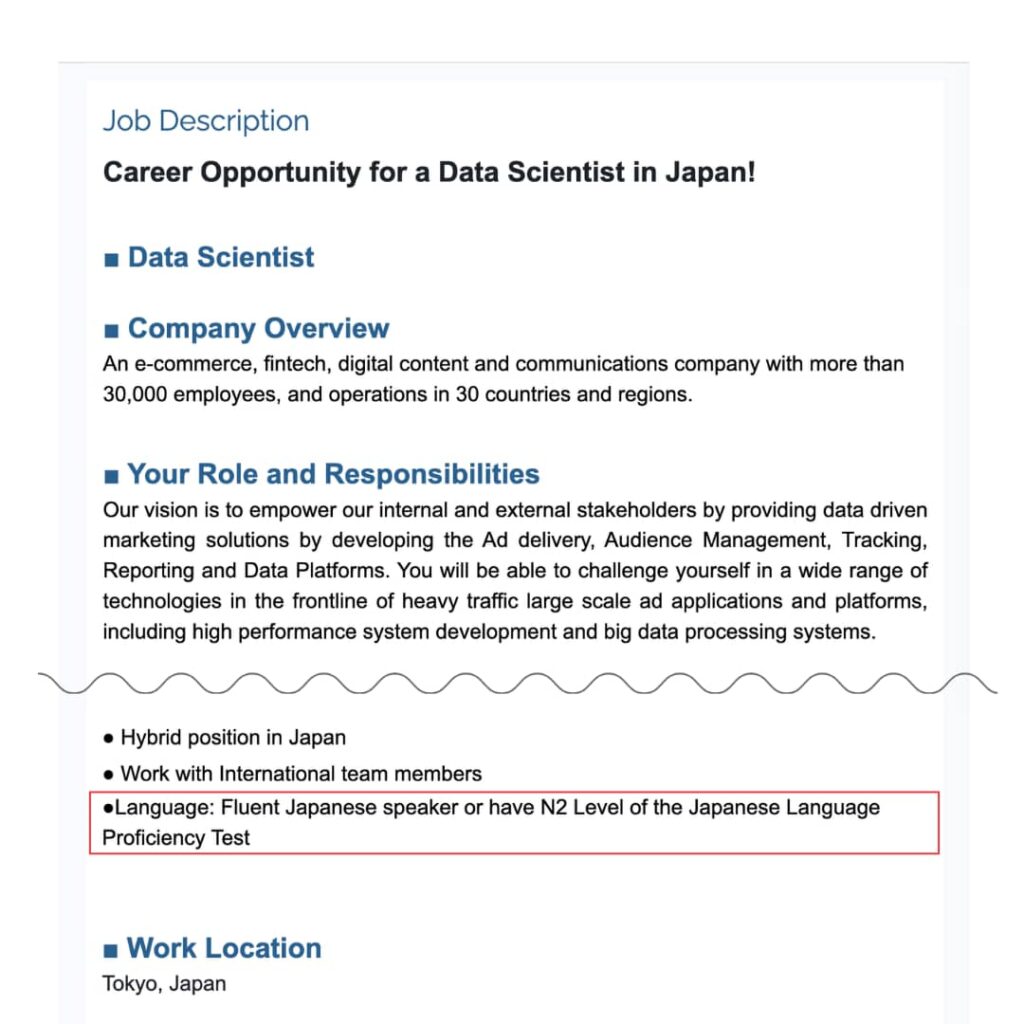
When a description says “business-level Japanese,” ask about the work behind the label:
- Which language is used in interviews and technical assessments?
- Which language is used in team meetings, documentation, and code reviews?
- Does the role involve Japanese-speaking customers or other departments?
- Is a particular test certificate required, or is proficiency assessed through interviews?
Give concrete examples of your current ability. “I can explain project progress in Japanese, but I need support with contract discussions” is more useful than an unsupported claim of fluency.
If a listing includes several language levels without clearly selecting one, ask for clarification. Do not choose the most favorable interpretation yourself.
4. Separate Work Location, Overseas Applications, and Immigration Arrangements
These conditions answer different questions. A company may offer remote work while requiring employees to live in Japan. Another employer may accept applications from overseas but require relocation before the start date.
Where must you live and work?
Check the stated work location and any office-attendance requirement. For a hybrid role, ask how often employees attend the office and whether onboarding follows a different schedule. For a remote role, ask which countries or regions are permitted.
Can you apply while living outside Japan?
Look for an explicit statement about overseas applicants. If none is provided, ask whether the employer considers candidates who are currently abroad and what location requirements apply at the application and start dates.
What does the employer mean by visa or relocation support?
Ask the hiring company to explain the support available for that specific role. Immigration paperwork, professional fees, flights, temporary accommodation, and moving expenses are separate items. Do not assume one includes the others.
A job offer or an employer’s willingness to assist does not itself establish immigration eligibility. The Ministry of Foreign Affairs’ working-visa guidance explains the Certificate of Eligibility, a document issued by a regional immigration authority, and notes that even this certificate does not guarantee visa issuance.
Confirm immigration procedures through the relevant authorities or an appropriately qualified professional. Ask the hiring company about its own support arrangements.
5. Check Employment Terms Before Investing in a Long Application
A role can fit your skills and still be unsuitable because of its contract, compensation, or working arrangements. Identify your non-negotiable conditions early.
- Employment relationship: Who will employ you? Is the position permanent, fixed-term, agency-dispatched, or an independent contracting engagement?
- Compensation: Is the figure annual or monthly, and is it gross pay before deductions? What does it include?
- Pay components: Ask about base pay, bonuses, equity, and any fixed overtime allowance. If an allowance is included, ask for its amount, covered hours, and treatment of additional overtime.
- Working arrangements: Check office attendance, scheduled hours, core hours, and any on-call responsibilities.
- Timing: Confirm the expected start date and whether it is compatible with your notice period and any required relocation.
If the salary is described only as “negotiable,” ask about the budgeted range before committing to an extensive interview process. A missing figure does not tell you whether the role meets your expectations.
6. Decide: Apply, Clarify, or Move On
After reading the listing, use this simple decision checklist.
- Apply when you can demonstrate the essential experience and the stated language and location conditions fit your circumstances. Tailor your application to the work described.
- Clarify first when an important condition is missing, contradictory, or open to interpretation. Ask a focused question and include the job title or reference number.
- Move on for now when a confirmed condition conflicts with your needs or qualifications. Record the reason so you can search more effectively for the next role.
Keep a short note for each promising vacancy: the link, date checked, strongest matching project, unresolved questions, and next action. This helps you compare opportunities without relying on memory.
A Message You Can Adapt
The following is a sample message. Replace the bracketed details with accurate information.
Hello [name],
I am interested in [job title / reference number]. My experience in [relevant project or responsibility] appears to match the role’s focus on [specific requirement].
Before applying, could you clarify [one or two specific questions, such as the language used in team meetings or whether applicants currently living overseas are considered]?
I am currently based in [country or city], and my Japanese ability is [brief, accurate description]. Thank you for your guidance.
Find a Role You Can Assess with Confidence
Use this checklist alongside our featured English-speaking engineering opportunities in Japan. Open each job description and confirm the latest conditions before applying.
Ready to build your shortlist? Explore IT/Tech Jobs in Japan.
If you would like to discuss your job search, learn about Talisman’s recruitment services for candidates. Bring a clear summary of your experience, preferred roles, and working conditions to help explain what you are looking for.
Sources and Further Reading
- Talisman: Data Scientist, Job ID 75965 — listing published September 23, 2026; checked September 28, 2026. Requirements and availability may change.
- Ministry of Foreign Affairs of Japan: Working visa — page dated March 17, 2023; checked September 28, 2026.
- Talisman: Services for individual clients — checked September 28, 2026.