


Executive Summary
Have a technical interview coming up for a job in Japan? Start by confirming what you will be asked to do.
- For live coding, practise solving and testing a problem while explaining your choices.
- For system design, practise turning requirements into a design and discussing its trade-offs.
- For a take-home task, confirm the expected effort and deliverables. If the task involves code, include clear instructions so the reviewer can run it.
Also ask which language the interview will use and which tools are permitted, including AI assistants. You do not need to prepare for every possible assessment at once. Use the comparison and checklists below to focus on the format you have been given.
What Should You Confirm Before You Start Preparing?
Read the assessment invitation alongside the job description. If important details are missing, ask the hiring contact or the recruiter handling your application.
- Format: Will you write code, discuss a design, review existing code, explain a past project, or complete an assignment?
- Timing: What is the session length? For an assignment, what are the expected working time and submission deadline?
- Language: Should you explain your approach in English, Japanese, or both?
- Environment: Will you use a shared editor, your own development environment, or a drawing tool?
- Tools: Are documentation, internet searches, libraries, code completion, or AI assistants permitted?
- Deliverables: What should you submit, and how will it be reviewed?
A useful message is: “Could you confirm the assessment format, expected duration, permitted tools, and the language I should use to explain my approach?”
This approach is consistent with Amazon’s official software development interview guidance, which advises candidates to ask their recruiting contact about the subjects and skills they will discuss. (Amazon’s guide describes its own hiring context, rather than a process shared by all employers in Japan.)
Which Practice Exercise Matches Your Assessment?
| Assessment | Useful practice | Question to review |
|---|---|---|
| Live coding | Solve a small problem, explain your approach, and test the result. | Can another person follow my reasoning and see how I checked correctness? |
| System design | Sketch a system from stated requirements and explain the main trade-offs. | Can I justify each important design choice? |
| Take-home task | Complete a small assignment with the requested documentation and checks. | Can a reviewer understand, assess, and, where relevant, run my submission? |
Choose practice that resembles the confirmed assessment. A timed algorithm exercise, an API implementation, and a code-review discussion require different preparation.
How Should You Prepare for a Coding Interview?
Practise making your reasoning visible, not just producing a final answer. Use a permitted programming language that you can write, test, and explain confidently.
- Restate the task. Confirm the inputs, expected output, and important constraints.
- Work through an example. Use a small input to check your interpretation before implementing.
- Explain a straightforward solution. Describe the approach and any limitations you already see.
- Implement and test. Check a normal case and relevant boundary cases, such as empty input or repeated values, according to the requirements.
- Discuss improvements. Where relevant, explain time and memory costs and what changes as the input grows.
If you get stuck, explain what you have established and what remains uncertain. You might say, “This approach handles the example, but it repeats the same lookup. I am considering a different data structure to reduce that work.”
You do not need to narrate every keystroke. Aim to explain decisions clearly enough that the interviewer can follow and respond. If you need a moment to think, say so.
How Should You Approach a System Design Interview?
Begin with the problem before choosing technologies. Clarify who will use the system, what the system must do, and which constraints matter most.
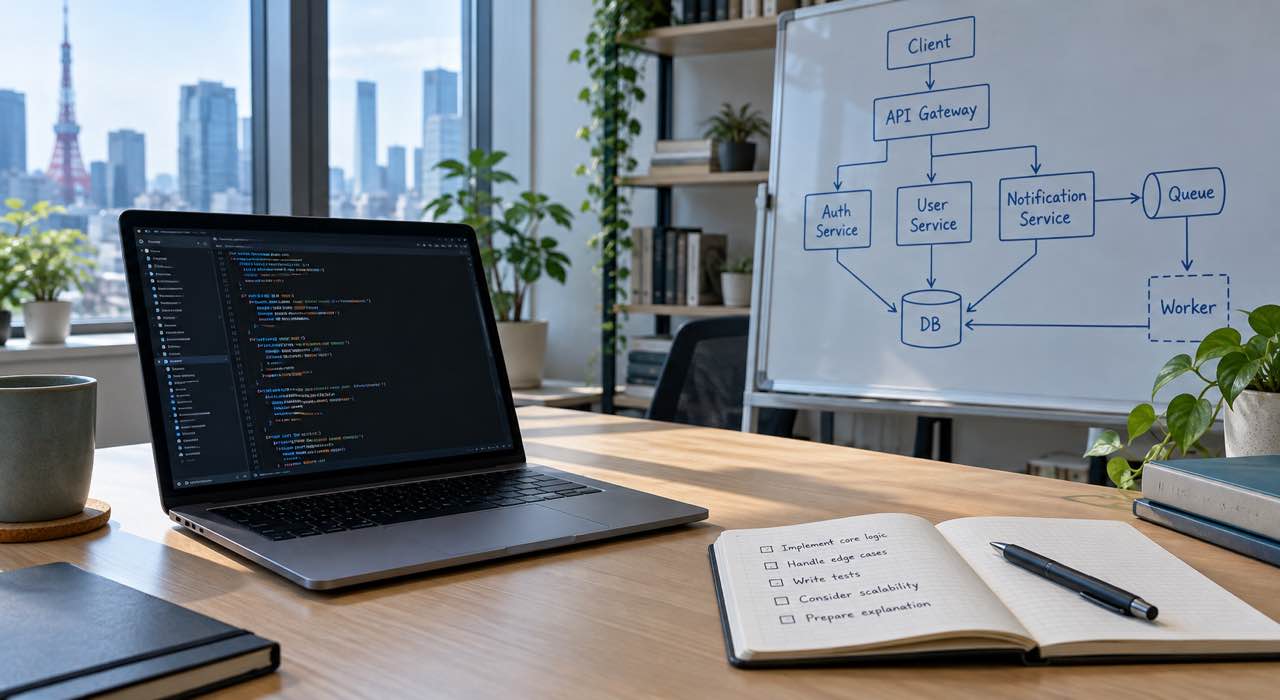
Illustrative practice task: Design a service that sends notifications.
Before drawing the architecture, ask:
- Which notification channels are required?
- Must delivery be immediate, or is some delay acceptable?
- What workload should the design support?
- What should happen when delivery fails or the same request arrives again?
Then sketch a simple data flow and explain one important decision. For example, a queue can separate request handling from notification processing. Explain how workers will handle failures, retries, and duplicate messages, and how you will monitor the system.
Also explain the cost of that decision: more components to operate, possible processing delays, and additional failure-handling logic. A diagram with more services is not automatically a better design.
If the interviewer leaves a requirement open, state a reasonable assumption and invite correction. Keep practice estimates clearly labeled as assumptions. Discuss access control, privacy, reliability, and scaling where they affect the proposed system.
How Can You Keep a Take-Home Task Focused?
Separate the submission deadline from the expected amount of work. Having several days to submit does not tell you how many hours the employer expects you to spend.
Confirm the required scope, permitted tools, and submission method. If the assignment appears larger than the stated effort, ask which parts to prioritize.
For a coding assignment, focus on:
- Required behavior: Implement the requested functions before optional features.
- Useful tests: Check important behavior and relevant failure cases.
- Setup instructions: Explain dependencies, configuration, and how to run the code and tests.
- Design decisions: Briefly explain meaningful choices and alternatives.
- Limitations: Identify unfinished work and what you would improve next.
Try the documented setup from a clean checkout before submitting. For a design or analysis assignment, make the assumptions, reasoning, and conclusions easy to follow instead.
Follow the requested repository visibility and access settings. Do not publish assessment materials without permission, or include confidential code, customer data, or credentials from a current or former employer.
How Should You Explain Your Previous Technical Work?
Prepare a concise example of a project relevant to the role. Explain the problem, your responsibility, a decision you made, and the result you can support.
Mercari’s recruitment guidance describes questions about candidates’ roles, actions, alternatives, results, and lessons learned. This is one company’s published approach, but those questions are also useful prompts for reviewing your own experience.
Be ready to distinguish your contribution from the team’s work. If an outcome was not measured, describe the verified deliverable rather than inventing a metric. Our guide to explaining technical project experience can help you select clear examples.
Can You Use AI While Preparing or Completing an Assessment?
Separate personal practice from assessed work. During preparation, you can use tools to generate original practice exercises or discuss concepts, but check their answers by reasoning through and testing the results yourself.
During an assessment, follow the employer’s explicit rules. Ask whether AI assistance and code completion are allowed, for which activities, and whether you must disclose their use. Permission to consult documentation does not automatically mean permission to use an AI assistant.
Also confirm whether assessment content may be sent to an external service. Do not upload confidential prompts, code, or data without permission. Whatever tools are allowed, make sure you can explain the work you submit.
What Should You Check Before the Session or Submission?
- Confirm the date, time zone, meeting link, and contact for technical problems.
- Test the required editor, drawing tool, screen sharing, microphone, and internet connection.
- Confirm the interview language and practise explaining key technical choices in that language.
- Review the rules for references, AI assistance, and other tools.
- Check submission files, repository access, setup instructions, and the deadline.
- Ask early about any accessibility arrangements you need.
Finish your preparation with a short rehearsal in the actual format. Use the rehearsal to identify one specific weakness to improve, such as explaining assumptions, testing boundary cases, or keeping a design discussion focused.
Frequently Asked Questions
Do all tech employers in Japan use coding tests?
Do not assume that every role uses the same assessment. Ask which exercises apply to your application and how they will be conducted. This guide covers possible formats, not a standard national hiring process.
Can I use AI tools during a technical assessment?
Use AI assistance only within the employer’s stated rules. If the policy is unclear, ask before using it. Confirm permitted activities, disclosure requirements, and whether assessment content may be shared with an external service.
What should I do if I cannot finish a take-home task?
Contact the hiring team before the deadline where possible and ask about priorities or timing. Follow their response. Clearly explain what you completed, what remains unfinished, and what you would do next. Do not assume an extension will be available.
Prepare for the Role You Want
Choose preparation that matches the vacancy and the assessment you have been given. If a recruiter is handling your application, ask them to clarify any unanswered questions about the selection process.
Explore IT/Tech Jobs in Japan and identify opportunities where your experience is relevant.